Short Story Month of May, Part 3
John Carr Walker Sitting In His Little Room No. 97

This week and for the whole month of May, I’m doing something a little different in The Little Room. It’s short story month! Stories in May don’t seem to enjoy the same attention as poems in April, and I’d like to do my part to remedy that.
Below you’ll find my brief annotations on seven short stories, all published in recent editions of literary magazines, online and in print. I’ve linked to everything I can, to make it easy for you, readers, to leave this newsletter and read some stories! Last week’s John Carr Walker Sitting In His Little Room includes links to and annotations on ten stories. And here’s the link to the first ten stories and annotations.
Far below, see information on a different kind of short story contest and public reading I just finished jurying with my university students and Two Rivers Books. Submissions are closed, but if you’re in the greater Portland, Oregon area, please join me at Two Rivers Books for the finalist readings!
Annotated Bibliography 5/18-5/24
5/18. “The Blob Takes Manhattan,” Chelsea Stickle, Fractured Lit May 6, 2024. About The Blob, risen from a thawed Arctic, consuming the world. The writing is energetic, filled with crisp description that describes more than its subject, cluing us in on point-of-view: middle-class American. I love the second half of the story, when the author turns the spectacle around and considers what The Blob must feel, and why The Blob keeps consuming.
5/19. “Wild Creatures,” Becky Hagenston, Literary Matters Issue 16.1. About a professor who does something unforgivable she can’t remember at a New Year’s Eve Party; in an attempt to move forward from the incident, she visits her grandmother who lives in a cabin in the Mississippi woods, but she’s having a drama of her own. It’s the contrasts between the two women that strike me: their different ages, social milieus, and responses to threats, not to mention the contrasting natures of the threats themselves. I love how the offense at the party becomes smaller and less consequential while the grandmother’s offense comes into focus, looms larger, and creates a bond of respect between the younger woman and the older.
5/20. “While Working on André’s Farm in France,” Greg Gerke, The Rupture 120. An American in France sits around hating everything while he delves back in his memory to remember those times when he sat around and hated everything. The style teaches the pleasure of skimming. Okay, I didn’t like the story very much, but I’m always impatient with stories that cleverly (or insufferably—I’m not sure there’s a difference) bury the one thing that matters in the chaff.
5/21. “Elbow in Zulu,” Dara Kell, The Masters Review April 8, 2024. About a privileged group of South Africans who meet weekly to walk their dogs, do good, and gossip, until their de facto leader gets entangled in a years’ long immigration saga. The style is straightforward, almost documentary-like, (the author is a documentarian by trade), but driven by the narrator’s disapprovals and judgements—the narrator tends to see a reason for everything, and most often the reasons are political, economic, or racial. Reading about a Congolese immigrant whose past might be a fabrication, and about his benefactor who might be in love with him, and the heartbreak that arises from the situation, through the lens of social power bolstered by generations, is uncomfortable, but the effects are moving.
5/22. “All Made-Up,” Megan Baxter, Diagram 24.1. About a bride who hires a make-up artist to make her look like someone (or something, anything) else on her wedding day. It’s written in the style of a product review, but one that forgets itself, and reveals much more about the narrator than about the product. The beginning of the story is hilarious—see the list of things the bride would rather look like—but it gives way to an aching kind of sadness, part longing, part frustration.
5/23. “My Mother and Your Mother,” Jessy Randall, Eclectica Volume 28, Number 2 (April/May 2024). About a pair of friendships between two mothers and two daughters, neighbors, who fall out, move away, and lose touch. The author notes the story is based on an old children’s rhyme, but the voice, prose, and landscape feel gritty and up-to-date. I like how the focus shifts from witnessing the fight between the mothers to what people remember about the fight, the gossip people keep spreading about the fight, and how that shift complicates the narrator’s own first-hand memory.
5/24. “Teddy Bear Juice,” Elissa Matthews, Lost Balloon May 22, 2024. About a bad dream that bleeds into real life and casts the narrator’s fifteen-year marriage in a new light. The style is driven by voice, but a voice in service to the story, energetic but controlled, perfect for this kind of outward-spiraling structure. I love that the story refuses to become a crisis in the lives of the married couple, but it does become a quiet turning point, a moment of epiphany about who and what they are as a couple, and ultimately, another day in a long life together.
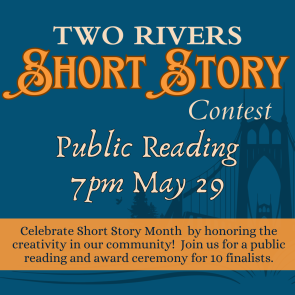
Join me at Two Rivers Bookstore to hear finalist short stories read by the authors!